Nerd Corner: The Golden Orb Shawl

Ginger writes:
A spider in my house is perfectly safe. This has nothing to do with a love of spiders, or an eco-friendly need to spare bug eating predators, or even a Buddha-like moral sense. No. I have such a phobia of spiders that I can’t stay in the same room or calmly comment about a spider’s presence so someone else can deal with the “emergency.” They are perfectly safe because I can’t get close enough to sweep one out the door — never mind kill one.

Spider Silk Textile

Spider Silk Textile Panel (Lamba Akotifahana), 2008. Madagascar. Seven panels joined: spider silk, plain weave with supplementary brocading wefts and patterning warps. Source: Art Institute of Chicago.

Picture, if you will, a large spider innocently walking across a room, blocking the only exit. And then picture a woman standing on a step stool (spider might run across the floor in her direction) with a broom to keep said spider at bay and wearing dishwashing gloves (spider might actually touch the broom). Her heart is pounding; she is sweating profusely. My son was amused, especially since his mother squealed like a little girl as he scooped up the spider and took it outside. I was decidedly NOT amused!

Now imagine the mix of fascination and revulsion I felt when I read about a piece of fabric woven from golden orb spiders’ webs! (Read some amazing exhibition notes from The Art Institute of Chicago and The American Museum of Natural History and the Victoria and Albert Museum on their spider silk textiles.) I had to read the articles and then look at the pictures of the fabric. It is an amazing golden color that shimmers and has a brilliant visual texture. It is absolutely stunning. Simply, wordlessly stunning! Who did it and how? Here’s a link to a high-res photo of the spider itself.

Detail of embroidered cape made of spider silk, made by Simon Peers and Nicholas Godley, 2011

Detail of an embroidered cape made of spider silk, made by Simon Peers and Nicholas Godley, 2011. Source: Victoria and Albert Museum.

A spider’s web is a sticky net in which it snares its supper. And the golden orb spider (Nephila spp.) spins one  that can span 15-20 feet, or more! Their webs are elastic and amazingly tough, and yes, they are golden in color. I live in Florida where golden orb spiders are ubiquitous. Here they are called banana spiders because of their large yellow abdomens. The spider that lives in that web is HUGE!

I will never weave a fabric made from the filaments of any spider web. I can’t touch it or even begin to imagine collecting the raw material! But I’m grateful that some else can. I’d love to see the shawl in person but I don’t think I could ever actually touch it. So spiders and their webs are perfectly safe from me…give me a venomous reptile any time!

Ewephoric Spinning Academy

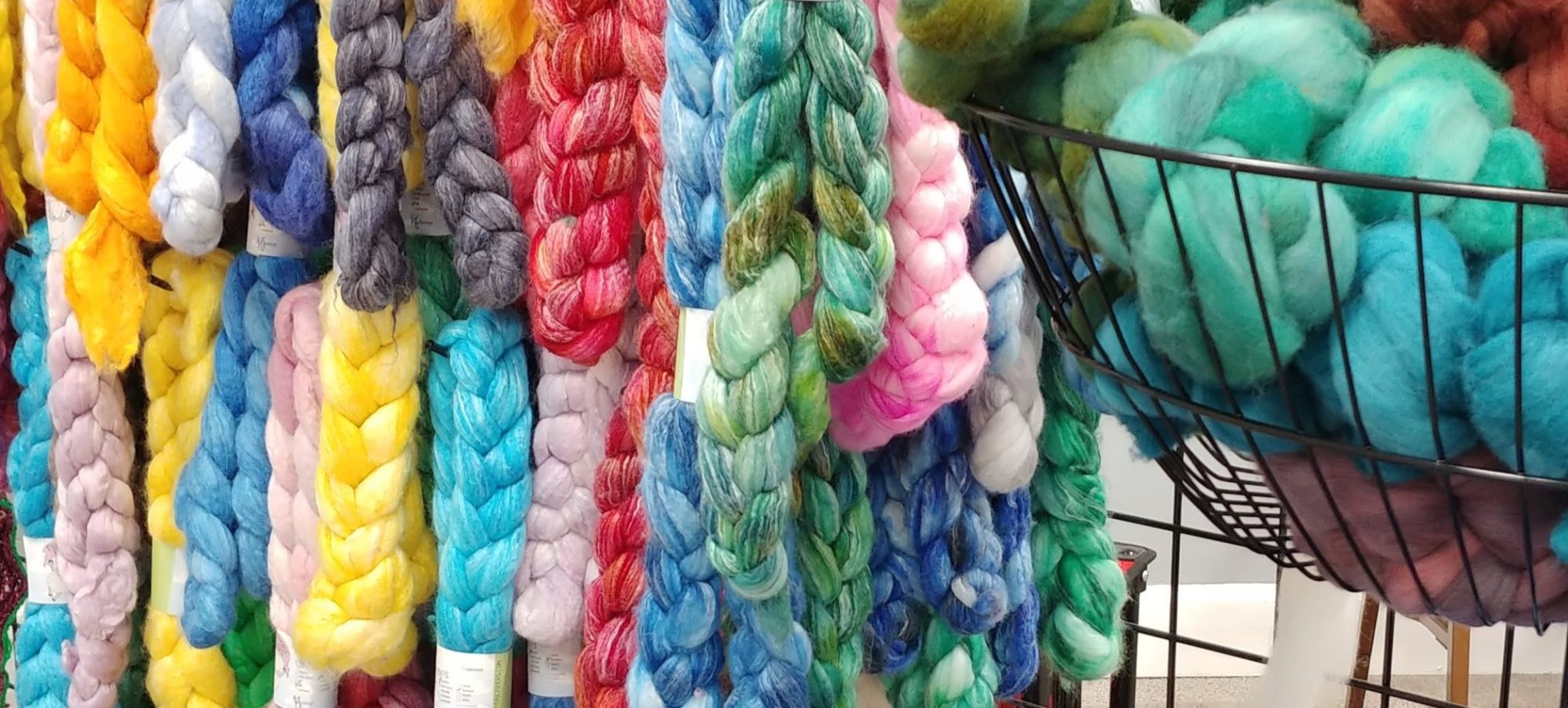
Wild Roving, Tamed

Wild Roving, Tamed

Join Ewephoric Fibers for an informative and fun-filled day of spinning. In the morning portion of the workshop, we will spin wild roving and batts. In the afternoon, we will work on plying to make the best possible yarns. While we are learning about wonderful fibers, we will also be helping a most worthy cause, Peaceful Paths. This non-profit group assists women moving out of abusive situations into a position of self-sufficiency and strength. Ten percent of every workshop fee will go to Peaceful Paths. Feel free to bring a non-perishable food donation for their food pantry. Details after the jump…

Continue reading “Ewephoric Spinning Academy”

“Green Cashmere” Field Work on the Patagonian Steppes

Many of you know that Ginger was headed to Argentina to interact with cashmere goat herders and the guanaco cooperative (www.payunmatru.com). After an overnight flight from Houston, TX to Buenos Aries, Argentina then an overnight bus ride to Junín de los Andes, the real adventure started! And yes, that is two days of travel to get to the beginning!

Grupo Costa del Rio Colorado cooperative

Ginger (far left) and the Grupo Costa del Rio Colorado Cooperative

Ginger writes:
Susan Walker, who works with the Wildlife Conservation Society (facebook.com/WCS.Patagonian.and.Andean.Steppe), and her husband, Andres Navarro, are long time friends and sponsored my visit to Argentina. They live in Junín and work in the Patagonian Steppe on habitat restoration for the benefit of threatened and endangered species such as the Andean cat, Darwin’s rhea, hairy armadillos and guanaco. As part of the effort to improve the habitat, WCS has been working with the local goat farmers to reduce over grazing of the fragile grasses allowing the return of the guanaco migrations and population expansion of animals that depend on the steppe for survival. Many of the local goats produce a cashmere undercoat, which increases the individual animal’s value. The herders are forming cooperatives, working with WCS veterinarians on better husbandry, and learning how to improve the quality of the cashmere through breeding management programs and by combing out the cashmere at the appropriate time.

Goats playing on the steppes

Goats playing on the steppes

I traveled to the Patagonian Steppe to observe the conditions of the farmers and animals, consult with the farmers to assist with improving the quality of the animals and fiber, and purchase raw cashmere. A day’s driving brought us to our first stop at the Grupo Costa del Río Colorado cooperative. This group is incorporating sustaining husbandry to reduce herd size and improve cashmere production. I was able to purchase a quantity of raw cashmere, which represented a 10% increase of their annual income. This was the first purchase of “green” cashmere: cashmere that was produced in a sustainable, environmentally friendly manner! It was very exciting to be part of this momentous event!

Guard dogs in training

Guard dogs in training

We visited another group, the Carrizalito Cooperative, and I was able to purchase more cashmere. Members of this group are incorporating guard dogs into their herds to reduce loss of goats to predators, mostly the puma. Where the dogs have integrated, the program has been a success! Both of these groups are working toward or have applied for Wildlife Friendly Certification from WCS (www.wildlifefriendly.org).

Migrating Guanaco

Migrating Guanaco

We drove through the Payunia reserve on our way to El Aguita where we spent a couple of nights. Along the way we observed large herds of guanaco migrating from wintering feeding grounds to the summer grounds. We had a meeting with the cooperative (www.payunmatru.com) who are shearing the guanaco. We discussed marketing, fiber, processing, I was able to evaluate the handspun and mill spun yarns. I was not able to purchase any guanaco on this trip, but Ewephoric Fibers still has a quantity available through our Etsy shop.

First ever sale of Green Cashmere

First ever sale of Green Cashmere

I will work with these groups to assist them in producing the best possible, sustainable cashmere by consulting on breeding programs, fiber collection, and by introducing this luxurious fiber to hand spinners and fiber artists through Ewephoric Fibers! Be sure to keep checking back with us as we process the raw cashmere into exquisitely soft and luxurious spinning fibers! I will share more tales of travel and keep everyone informed of the progress!

Road Trip: Destin-y Bound

We are very excited about going to the January Spin-In in Destin, Florida.  This small gathering is such a wonderfully relaxing venue that we sign up for it as soon as possible!  We will have lots of luxurious and luxury fibers, BFL, BFL with silk, Tussah and Bombyx silk roving, cashmere, guanaco and some special blends.

Hope to see you there!

Stars in Our Eyes Fiber Club

Crab Nebula

Jane and Ginger are very excited about introducing our first ever most fabulous fiber club! We will be stargazing through the Hubble telescope (pictured above, the Crab Nebula). Each offering will feature 4 ounces of roving or custom carded batts in an astronomical colorway along with suggested spinning directions. One of the months will feature a blend of luxury fibers. You will receive your fiber 4 times a year, about every 3 months. Cost is $120/year, shipping included.

Order it now via . . . → Read More: Stars in Our Eyes Fiber Club

October News

Ewephoric Booth at the Florida Fiber In

Ginger writes:

Did you join us at the Florida Fiber In? We had a wonderful time! We met old friends and made new ones. The demos were great! I learned Navajo 3 ply on the fly; a bit more practice and I’ll actually be good at it. Tacking down the loop was the aha-moment! I gave a demo on Taming the Wild Roving. We talked about how to get the yarn you want from multi colored roving that has all the colors you love, but not necessarily in a complimentary format. . . . → Read More: October News

Dyeing Like Crazy

Right now Ginger and I are dyeing like crazy getting ready for SAFF in North Carolina. We can hardly wait. Hope to see some of you there! Stop in and say hi, and take a peek at our no longer top-secret fiber club we are debuting (which will be up on the website shortly).

Cheers, Jane.

Ewephoric Fibers Road Show

Ginger in the Ewephoric Fibers Booth

Join Ewephoric Fibers (www.ewephoricfibers.com) at the Florida Fiber In (www.floridafiberin.org) inOrlando,September 16-18, 2011. Attendance is free, although a donation at the door will help to defray costs. Come on in, even if you have not pre-registered!

We will be launching a bunch of new products you won’t want to miss:

Dreamtime Roving BFL (80%)/ Silk (20%): the softness of BFL combined with the sheen of silk becomes a dream sliding through your fingers. You will LOVE the yarn from this exquisite roving! Parfait Batts: Luscious custom carded batts in layers of analogous . . . → Read More: Ewephoric Fibers Road Show

Keep Your Fibers Safe!

Ginger writes: We all have fiber and or yarn stashes that are squirreled away awaiting that perfect project. We have all had the experience of opening our stash and, horror of horrors, discover a little cloud of moths! Or you find a little pile of gritty dust. Your natural fibers can become dinner for moths, silverfish, roaches and other insects. Mice also find that nice warm fluff a fine place to raise a family. So how do you protect your treasures from unwanted company and damage?

Fiber Moths (Clemson University – USDA Cooperative Extension Slide Series, Bugwood.org)

There . . . → Read More: Keep Your Fibers Safe!

Why do you spin?

Ginger's Workshop

Ginger writes: Why do you spin? Why in this day and age of readily available, immediate gratification yarn stores and online shops would you want to spin individual strands of fibers into yarn?

Me? Why do I spin? There are reasons I can delineate and many others I simply cannot.

I spin to produce the specific yarn I want for a specific project. Sometimes I find a pattern that I particularly like and plan out the yarn I will use. I select the fleece, wash, dye, card, and then spin to the weight I want. I . . . → Read More: Why do you spin?